

Rakiya A.Muhammad
The air buzzed with excitement as participants stepped into a vibrant celebration, where Bavaria’s rich cultural heritage took the spotlight after days of inspiring scientific exchange at the 75th Lindau Nobel Laureate Meeting in Germany, uniting 75 Laureates and more than 600 young scientists.
The social event capped off days brimming with stimulating lectures, lively panel debates, creative partner exchanges, high-energy Synergy/Lighting/Focus Talks, the uplifting Nobel Hour, and invigorating science walks.
As the Bavarian Evening unfolded, the gathering of brilliant minds transformed into a vibrant expression of tradition and shared festivity.
Scientists and delegates found a rare chance to connect beyond their research, delighting in the shared humanity that bound them together.
For many, science fostered connection, while culture enriched their experience with vibrant hues.
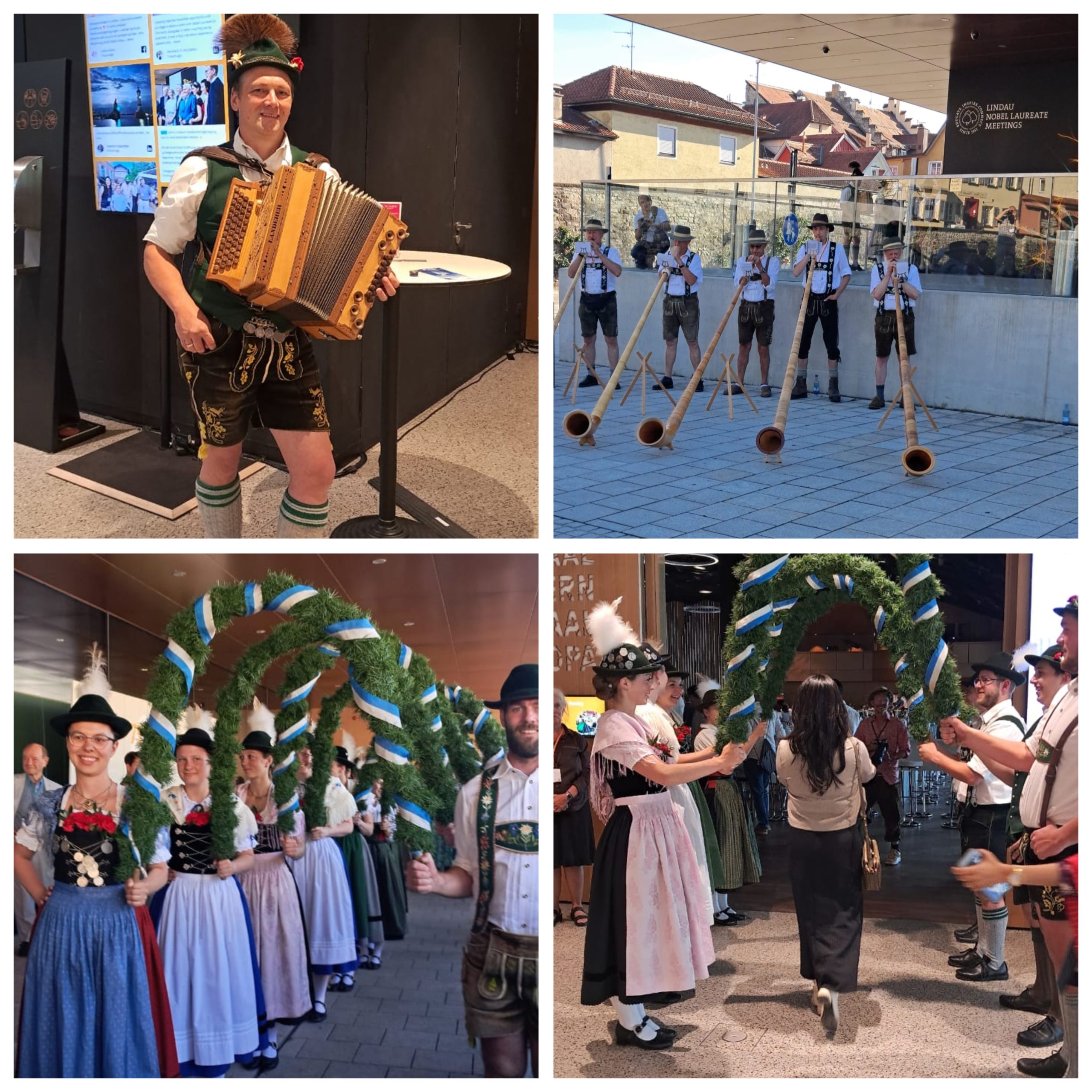
The evening began with a dynamic performance by Bavaria’s talented performers. Their alpine horns resonated throughout the venue, highlighting pride, tradition, and unity.
With vibrant costumes, rhythmic beats, and lively steps, the performance captured the dynamic spirit and enduring traditions of Bavaria. It served as a joyful welcome, inviting everyone to join in the celebration of diversity and unity.
Guests savoured Bavarian cuisine, known for its hearty simplicity and rich flavours from local produce and traditional dairy products, paired with local beverages.
Together, the get-together inspired cross-cultural understanding, appreciation, and collaboration among the international scientific community.
And what better way to celebrate diversity than through the lively display of traditional attire from across the globe?
Each costume became a window into a world of history and artistry, a vivid reminder of the creativity woven into every culture.
From Tracht, the traditional clothing of Bavaria, to the unique regalia found across continents, the event became a living gallery of how people worldwide express identity through attire, each piece woven with tradition and values.
Echoes of History & Nobility
Johanna’s face lights up as she proudly displays her Bavarian outfit. She shares how wonderful it is to be at the event, mingling with captivating people from across the globe.
Bavarian traditional clothing, known as Tracht, includes Dirndl for women and Lederhosen for men, reflecting the region’s cultural heritage and festive traditions.
Johanna wore the Dirndl, a proud symbol that blends timeless craftsmanship with modern flair, expressing both social and regional identity.
From the Scandinavian Peninsula in Northern Europe, Nina, a Swede, stood proudly in an elaborate Swedish folk costume, a striking piece of 18th-century fashion with a full skirt, vest, lace-trimmed blouse, and sparkling jewellery.
An elated Nina says, “I love this week. This is one of those weeks when you are extremely tired by the end, but at the same time you meet different people and feel so full of energy. You get inspired every second here.”
After five years of coming as a guest, Nina says she feels a genuine joy each time she returns to take part in these meetings.
She underscores the importance of sharing within the science community, adding that at a partner breakfast, the focus on science diplomacy reminded her that, at its heart, it is about sharing knowledge and shaping the world we all share.
From the United Kingdom, Ben stands out with a fashion statement that captures British elegance. His menswear blends timeless heritage with modern practicality, complete with a classic bowler hat and bell pads, both cherished symbols of British tradition.
“This is what most men wear in summertime when they have a little dance,” Ben says. “I feel like a ring day,” he adds, stomping his feet so the bells strapped to his knees burst into a bright, joyful rhythm.
Expressive Patterns of Roots and Diversity
Emerging from the sweeping savannahs of Africa, three young Nigerian scientists arrive, draped in vibrant traditional fabrics from the southeast and southwest. Their attire tells stories of Igbo and Yoruba heritage, each thread woven with generations of artistry and pride.
“I am wearing the Akwaete fabric from Abia State, southern Nigeria,” Chinasa says. “Representing Abia State in my traditional Akwaete attire is a moment of pride and respect for the State that nurtured and shaped my academic journey.”
She notes that the Bavarian Evening connects people and cultures. “I feel so good learning different cultures from different countries; it makes me feel so good.”
Oyinoluwa and Ezekiel are also adorned in Adire fabrics, their vibrant patterns a living canvas of Yoruba culture and heritage. Oyinoluwa, proudly showcasing her attire, says, “I am putting on Adire fabric. I represent the Yoruba culture. I am a Yoruba woman. I feel so excited; it’s very nice we get to see different cultures, the Bavarian culture and everything.”
Ezekiel, swept up in the joyful energy of the event, says, “I feel good.”
Continuing the celebration of Adire, Rhoda from Kenya embraces Pan-Africanism, saying, “I am Kenyan, yet today I wear Nigerian attire. The fabric’s patterns reveal their West African roots, distinct from those of the East. As an African representing another African country, I feel proud. Africa is a continent, not a country, and I am honoured to wear something from the West while coming from the East.”
From the smiling coast of Africa, the Republic of The Gambia, celebrated for its vibrant culture, storied past, and breathtaking landscapes, Musa dons the Grand Boubou, the traditional attire of Gambian men, radiating the pride and heritage of his people.
The Grand Boubou, a striking three-piece ensemble of tunic, trousers, and a flowing outer gown adorned with intricate embroidery at the neckline, stands as a symbol of respect and dignity.
“I am here at Lindau, where 600 scientists gathered to discuss science. I feel so excited to be here,” he says.
We meet Jaymi, hailing from the southernmost tip of Africa. South African women’s clothing bursts with vibrant colours, dazzling beadwork, and unique patterns, each piece linking heritage and history.
Jaymi brims with excitement, enthusiasm, passion, and inspiration.
Flowing with Grace & Grandeur
Yoliima, a Kazan from China, dons a graceful traditional garment that beautifully showcases her vibrant heritage.
Poised and radiant, she expresses her delight in the cultural night, exclaiming, “I love immersing myself in these vibrant cultures and lively dynamics.”
Sethi, a proud Punjabi from India, the Land of Diversity, wears the turban—a signature headwear deeply woven into Punjabi identity, representing honour, self-respect, and spirituality.
For him, this event is truly special. “I have learned so much, and I love that it brings together people from different disciplines and cultures. It is a wonderful learning opportunity, and I am genuinely glad to be here, especially since I almost missed it.”
A vibrant echo of style and cultural meaning, Nidhi elegantly drapes herself in the saree, the iconic attire of Indian women, celebrated as a symbol of grace and femininity.
Beaming with excitement, Nidhi exclaimed about the Lindau Nobel meeting and the cultural night, “Oh my God, it is so exciting! It is amazing to see so many Nobel laureates in one place, and you are free to talk with everyone. It is truly amazing.”
From the island nation of Singapore at the southern tip of the Malay Peninsula, Lee proudly wears the Kebaya—a fitted blouse with a front opening, paired with a batik skirt or sarong. This attire, a symbol of Peranakan culture, radiates modesty and elegance, embodying the rich heritage and multicultural spirit of Singapore.
“I’m wearing a kebaya representative of the Peranakan culture in Singapore,” she says, with smiles, modesty, and elegance.
From the landlocked Kingdom of Bhutan in South Asia, Lama and Dolkar appear in the full splendour of traditional women’s attire: the Kira, paired with a long-sleeved blouse and a short jacket called tego. Their clothing is a proud symbol of national identity, cultural heritage, and unity.
For both, the excitement of joining a cultural night filled with diverse nationalities is matched only by the pride of wearing attire that embodies Bhutanese values and craftsmanship, connecting generations through traditional weaving.
From Morocco, a country at the crossroads of Europe, Africa, and the Middle East, renowned for its rich history and vibrant culture, Mariam wears a beautifully embroidered traditional garment. Her attire captures the elegance and heritage shaped by African, Arab, Amazigh, and Mediterranean influences.
She describes the event as incredible, one that has broadened her perspectives. “The organisation was excellent, and I especially enjoyed connecting with Nobel laureates and young scientists,” she says.
For attendees like Zeineb, the event sparked a joyful celebration of her dual heritage. With roots in Germany and Tunisia, she carries the stories of both Central Europe and the sunlit Mediterranean; her family is a blend of two vibrant worlds.
She drapes herself in a Djellaba, its flowing fabric a living symbol of Tunisian pride and centuries-old tradition.
The German-Tunisian remarks: “The cultural event was a reminder of what my culture looks like. I try to include my father’s culture, which is Tunisian, by wearing a traditional Tunisian gown called a djellaba, a long dress with many ornaments, which I really like. What I really like about the cultural event is that we have many different countries wearing their traditional gowns; it was really busy, full and diverse, and I really liked it.”
While borders may divide us, moments like these reveal that our greatest strength is found in the ties of our shared humanity. Culture acts as a vibrant bridge, inviting us to collaborate, understand one another, and build a foundation for enduring peace.
More than a conference, the Lindau Nobel Laureate Meetings stand as a tribute to the vibrant beauty of diversity, the unbreakable force of unity, and the boundless possibilities that emerge when the world comes together in exploration.
