
Rakiya A.Muhammad
Since Lawan Abdul embraced regenerative agriculture, his harvests have doubled, a result that embodies the promise of this approach. “It was both astonishing and uplifting for me,” he shares, his eyes alight with newfound hope.
He observes tangible changes in his soil: the earth feels softer and richer, teeming with a new life that wasn’t there before. The soil’s darkened hue and earthy aroma hint at its restored vitality—a testament to the power of regeneration, which now drives his approach.
Abdul exemplifies the success of Nestlé Nigeria’s Regenerative Agriculture pilot, where innovative methods like cover cropping, minimal tillage, crop rotation, and hedgerows have transformed fields into thriving, fertile landscapes, boosting yields and soil health.
His face lights up with fulfilment, his joy unmistakable as he takes in the results—a reaction shared by many who have seen tangible benefits from adopting regenerative practices.
“I am very happy with the outcome,” Abdul beams at a celebration honouring the pilot’s success, where five outstanding farmers were applauded for their bold embrace of regenerative practices.
Overflowing with gratitude, he appreciated Maggi, Nigeria’s leading seasoning brand, and its partners for opening the door to regenerative agriculture, a practice the Food and Agriculture Organisation (FAO), says works in harmony with nature.
Regenerative agriculture restores soil and boosts yields, creating holistic systems that improve water and air quality, enhance biodiversity, and support climate goals, according to the FAO.
“These farm systems are designed to work in harmony with nature, while also maintaining and improving economic viability.”
Saliem Fakir, Executive Director of the African Climate Foundation, passionately champions ACF’s commitment to research proving that regenerative agriculture benefits business, society, and the environment alike. He highlights, “It could increase yields by 170% in some regions in Africa. Smallholder farmers who produce 80% of our food are central in the transition towards a fairer, healthier, more sustainable farming model.”
Mapping the Path to Vibrant, Sustainable Farms
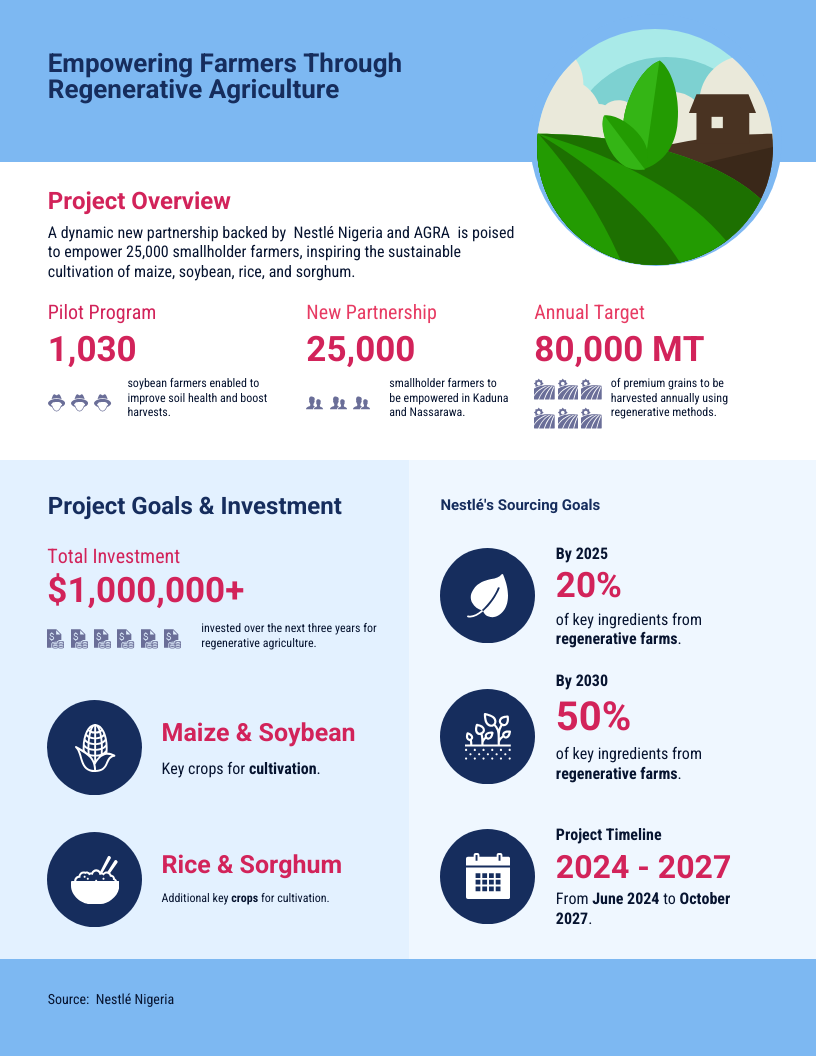
Launched in 2023 with over N100 million in backing, the pilot enabled 1,030 soybean farmers to improve soil health and dramatically boost their harvests by using climate-smart techniques—agricultural methods that reduce environmental impact and increase resilience to climate change. With support from TechnoServe, IDH, and Ghana’s Centre for No-Till Agriculture, the initiative marked a significant advancement for Nigerian smallholder farming.
Funmi Osineye, Category Manager for Culinary, Nestlé Nigeria, explains: “Soybean is a key ingredient in MAGGI, and supporting local farmers to grow it sustainably is central to our mission.” By using regenerative soy, MAGGI supports ecological health, strengthens local economies, and enhances the nutritional value of its products.
She emphasises that this goes far beyond a sourcing strategy; it is a daring commitment to cultivating robust food systems for generations to come.
“By equipping farmers, especially women and youth, with regenerative agriculture skills, we are improving productivity today and protecting the land for future generations,” Osineye explains.
“This is how MAGGI continues to nourish Nigerian families while helping build a stronger agricultural economy.”
Powering Resilient Food Futures
Riding on the pilot’s momentum, a dynamic new partnership backed by AGRA and Nestlé Nigeria is poised to empower 25,000 smallholder farmers in Kaduna and Nassarawa, inspiring the sustainable cultivation of maize, soybean, rice, and sorghum. To maintain this momentum, the project outlines a clear timeline: June 2024 to October 2027.
This ambitious drive targets an annual harvest of at least 80,000 metric tonnes of premium grains, with increasing shares grown using regenerative methods.
To Alidu Amadu, Head of Agriculture Services for Nestlé Central & West Africa, the project stands as a shining example of the transformation possible when businesses, partners, and farmers unite.
He adds that regenerative agriculture breathes vitality into the land, laying the groundwork for enduring productivity and more resilient communities.
Growing Sustainability: The Vision for 2030
The project accelerates Nestlé’s efforts to source 20% of key ingredients from regenerative farms by 2025 and 50% by 2030, reinforcing food security and rural growth nationwide. In line with global climate goals, the initiative underscores Nestlé’s leadership in sustainable agriculture.
Highlighting the company’s dedication to sustainable sourcing and a lighter environmental footprint, Nestle Nigeria CEO Wassim Elhusseini unveils a major investment plan to champion regenerative agriculture within a broader climate-smart farming vision.
“With an investment of over $1,000,000 in this project over the next three years, we aim to contribute towards establishing regenerative agriculture as the standard in the food industry, addressing both environmental and social priorities holistically,” he asserts.
He adds that the initiative, created in partnership with AGRA and TechnoServe, aims to strengthen sustainable farming and boost resilience for Nigerian smallholder farmers.
“At Nestlé, we believe that good food starts with high-quality ingredients and the well-being of the people who produce them,” stresses Elhusseini.
“Our partnership in this initiative underscores our commitment to sustainable sourcing and value chain decarbonisation.”
Adesuwa Akinboro, TechnoServe Nigeria’s Country Director, observes that regenerative agriculture brings dignity back to farming and paves the way for a more inclusive, sustainable future for communities across the participating states.
She classifies the project as a bold pledge to empower smallholder farmers and agribusinesses, arming them with vital tools, knowledge, and market access to thrive even as climate change looms.
Dr. Rufus Idris, AGRA’s Country Director for Nigeria, shares his pride in co-leading an initiative that uplifts farmers, sparks innovation, and breathes new life into the ecosystems that sustain agriculture—a cornerstone of AGRA’s mission to transform food systems.
The project, he points out, reflects AGRA’s commitment to strengthening food systems.
Harnessing Regenerate Practices to Drive Economic Growth
An Africa Regenerative Agriculture Study Group Report notes that while the transition can initially be labour-intensive, businesses adopting regenerative practices see yields rise by 68–300%. Strategic planning helps manage challenges, and large agribusinesses partnering with smallholders can accelerate the shift to ensure supply chain resilience.
The report finds that regenerative practices in Africa could increase Gross Value Added by over $15 billion annually by 2030 and up to $70 billion by 2040, a significant share of sub-Saharan Africa’s agricultural GDP.
“This in turn could create upwards of 1 million additional full-time jobs by 2030, reaching nearly 5 million jobs by 2040.”
This significant increase in GVA could result in substantial income gains for individual farming households.
Some beneficiaries of Nestlé Nigeria’s regenerative agriculture initiative recall how farming once felt like an uphill battle with few rewards. As they walk through their fields, they are confident that their dedication will produce strong harvests, supporting economic growth and lasting progress.
