
Rakiya A.Muhammad
United Nations Children’s Fund (NICEF) has urged all stakeholders to turn commitments into action and ensure that no child is left behind.
“Securing children’s rights requires more than policy commitments,” the organisation stated. “It demands sustained investment, effective service delivery, community ownership and collective accountability.”
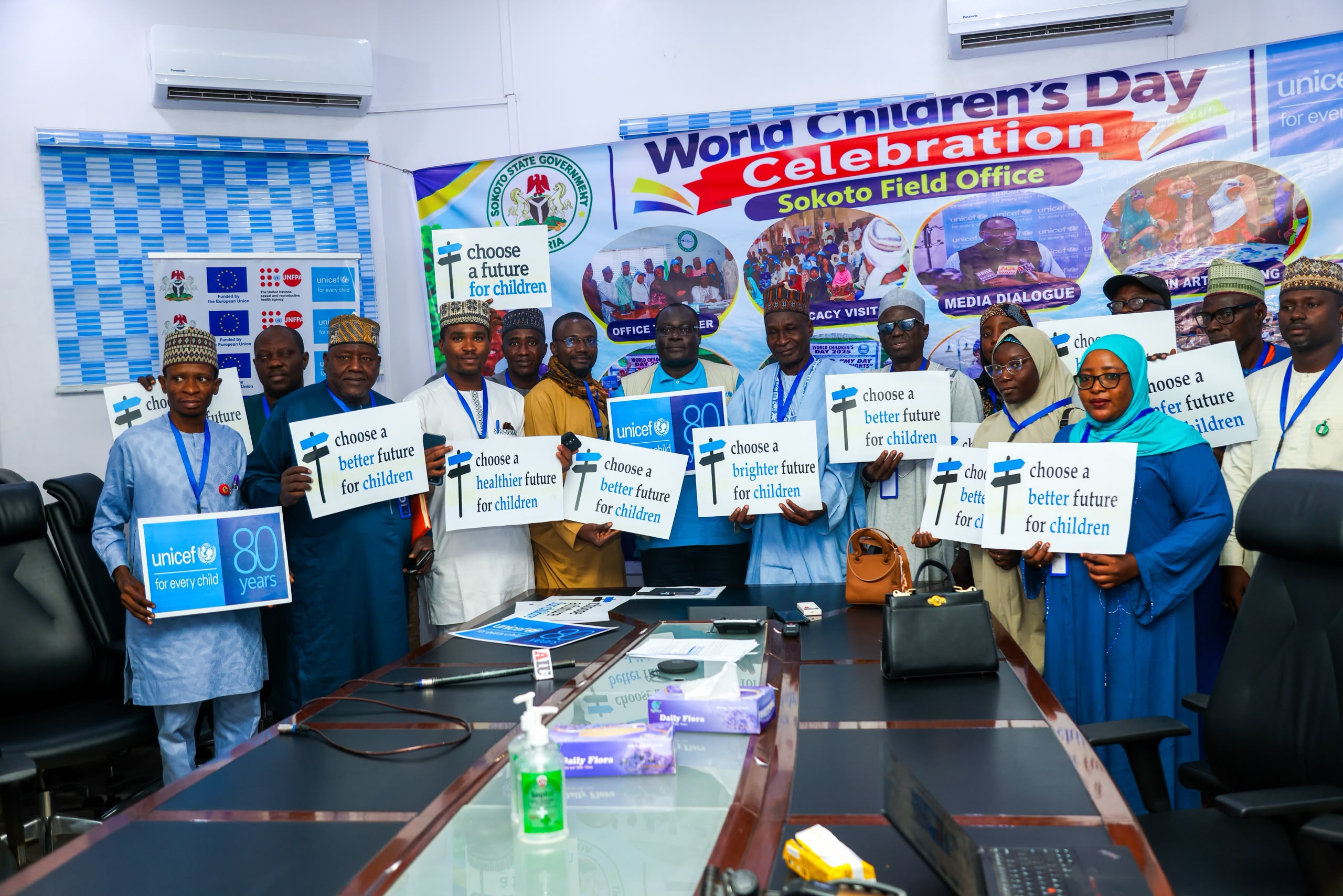
At a media briefing in Sokoto to mark World Children’s Day 2026, Chief of Field Office Dr Michael Juma called for stronger coordination at ward and local government levels.
He pointed out that delivering services successfully relies on the active involvement of government institutions, development partners, civil society organisations, traditional and religious leaders, community groups and parents.
Juma highlighted significant achievements made through UNICEF’s partnership with the governments of Sokoto, Kebbi and Zamfara, while also acknowledging that much work still lies ahead.
On education, he observed that of roughly 624,000 out-of-school children identified in Sokoto, Kebbi and Zamfara, re-enrolment efforts have reached only about 68,000. This highlights the urgent need for stronger government leadership, ongoing investment and community mobilisation to ensure every out-of-school child is fully reintegrated into the education system.
He said approximately 98,000 children have benefited from the Teaching at the Right Level (TaRL) approach, which improves foundational literacy and numeracy.
Juma reaffirmed UNICEF’s commitment to supporting teacher professional development, providing learning materials, accelerating basic education, integrating Qur’anic education and expanding innovative learning opportunities such as radio-based education and the Nigeria Learning Passport, especially for children affected by insecurity and displacement.
On health and immunisation, he revealed that in Sokoto, Kebbi and Zamfara States, around 7.8 million children received measles-rubella vaccinations. In comparison, over five million children were immunised during the most recent polio campaign.
The Chief emphasised that strong health systems and immunisation programmes provide an essential foundation for children’s survival, development and ability to benefit from education and other essential services.
He noted that through support for social health insurance, UNICEF has helped expand access to healthcare, reaching about 86,000 beneficiaries in Zamfara, 18,000 in Sokoto and 10,000 in Kebbi through these initiatives.
On nutrition, Juma stated that UNICEF remains committed to supporting government efforts to prevent and treat malnutrition.
The Chief acknowledged the contributions of the Sokoto and Zamfara State Governments, which committed approximately ₦100 million and ₦500 million, respectively, towards procuring Ready-to-Use Therapeutic Food (RUTF) to treat children with severe acute malnutrition.
He urged media organisations in Sokoto, Kebbi and Zamfara States to intensify advocacy, promote public accountability and amplify efforts to protect and fulfil every child’s rights.
Juma described journalists as key duty-bearers in advancing children’s rights, encouraging them to offer balanced coverage that celebrates progress and also shines a light on ongoing challenges affecting children’s wellbeing.
He reiterated UNICEF’s dedication to collaborating with government institutions, development partners, traditional and religious leaders, communities, and other stakeholders to guarantee every child access to quality, inclusive education, healthcare, nutrition, safe water, social protection, and a nurturing environment.
According to him, UNICEF has supported the development of child protection legislation, Family Court Rules and social protection policies to strengthen the protection, rehabilitation and reintegration of vulnerable children, including children in conflict with the law.
He added that the Field Office has supported the creation of a Special Care Baby Unit in Sokoto State, with similar projects underway in Kebbi and Zamfara States to enhance care for premature and low-birth-weight babies.
Regarding children in hard-to-reach and insecure communities, he explained that UNICEF partners with government structures, field facilitators, and third-party monitors to deliver services, track progress, and ensure vulnerable children and women are included in essential interventions.
He encouraged journalists to use their platforms to inform communities, spark demand for essential services, spotlight new challenges, and hold stakeholders accountable for promises made to children.
