

Rakiya A.Muhammad
A public dialogue on the relationship between science, civil society, and political responsibility has been scheduled for Saturday, June 27, in the run-up to the 75th Lindau Nobel Laureate Meeting.
Nobel Peace Prize Laureate Ales Bialiatski, former President of the European Commission José Manuel Barroso – who himself accepted the 2012 Nobel Peace Prize on behalf of the European Union – and former President of the United Nations General Assembly Han Seung-soo will come together for the dialogue, according to a statement by Lindau Nobel Laureate Meeting organisers.
“The event takes place on the eve of a meeting dedicated, among other things, to the themes of Integrity and Resilience – two concepts that carry particular weight when viewed against the backdrop of Bialiatski’s biography,” it stated.
The statement highlighted that Ales Bialiatski, founder of the Belarusian human rights organisation Viasna and the recipient of the Nobel Peace Prize in 2022, spent years in a Belarusian prison for his tireless commitment to civil rights and democratic freedoms.
“His presence in Lindau stands as a powerful reminder of what is at stake when the conditions for free inquiry – in science as in society – come under threat,” it pointed out. “His participation in the panel is one of the first public occasions with an audience he will take part in since being released in December 2025 after more than four years of imprisonment.”
What the dialogue will explore
According to the statement, the dialogue, planned to hold at the City Theatre Lindau, will explore a question that runs as a thread through the entire 75th Lindau Meeting: How can science contribute to the resilience of open societies? And what responsibilities do scientific institutions bear when democratic foundations are eroded?
“These are not abstract questions,” it stated. “At a time of deepening geopolitical tensions, the Lindau Nobel Laureate Meetings – founded in 1951 in the spirit of post-war reconciliation – reaffirm their founding conviction: that open dialogue across borders, disciplines, and generations is not a luxury, but a necessity.”
Prelude to a Historic Week
The event on 27 June sets the tone for the days that follow, the statement further stated.
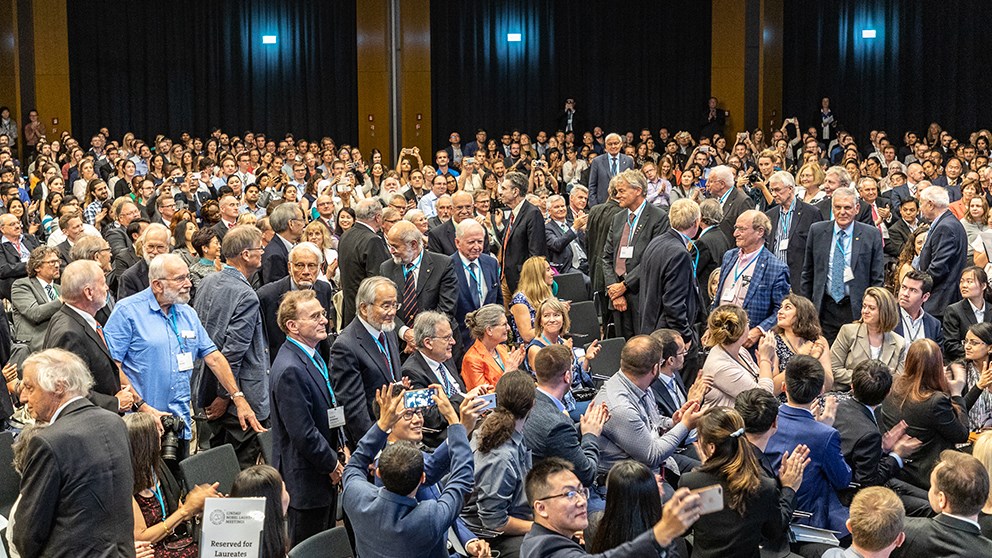
“From 28 June to 3 July 2026, around 70 Nobel Laureates and more than 600 Young Scientists from across the globe will gather in Lindau for the 75th Lindau Meeting (#LINO75) – the largest, most international and most diverse in the history of this unique forum,” it added.
“The interdisciplinary programme addresses the most urgent questions facing science and society: from artificial intelligence and quantum technologies to global health, scientific integrity, and the future of international cooperation. The presence of Ales Bialiatski makes one thing unmistakably clear from the outset: in Lindau, science is never discussed in isolation from the world it serves.”
The statement recalled that for 75 years, the Lindau Nobel Laureate Meetings have served as a unique forum for exchange between Nobel Laureates and Young Scientists, as every summer, more than 600 of the world’s most talented Young Scientists and more than 30 Nobel Laureates are invited to spend a week in Lindau on the German side of Lake Constance, a week full of mutual inspiration and scientific encounters.
“Since the first Meeting in 1951, more than 36,000 Young Scientists have participated in the Lindau Meetings – for many of them, it has been an experience that has changed their careers and lives, making them part of a unique international network of scientific excellence,” it disclosed.
“Even after years and decades, they are still connected with each other and with the Lindau Meetings through the Lindau Alumni Network.”
According to the statement, the original idea of the Meetings goes back to two physicians based in Lindau, Franz Karl Hein and Gustav Wilhelm Parade, as well as to Count Lennart Bernadotte af Wisborg, a member of the Swedish royal family who quickly became the spiritus rector of the Lindau Meetings.
“From the start, they saw the Meetings as a means to reconcile the peoples of post-war Europe, in particular, the younger generation,” it highlighted.
“Lindau quickly developed into an international forum for the exchange of knowledge between nations, cultures, traditions, and disciplines.”
