

Rakiya A. Muhammad
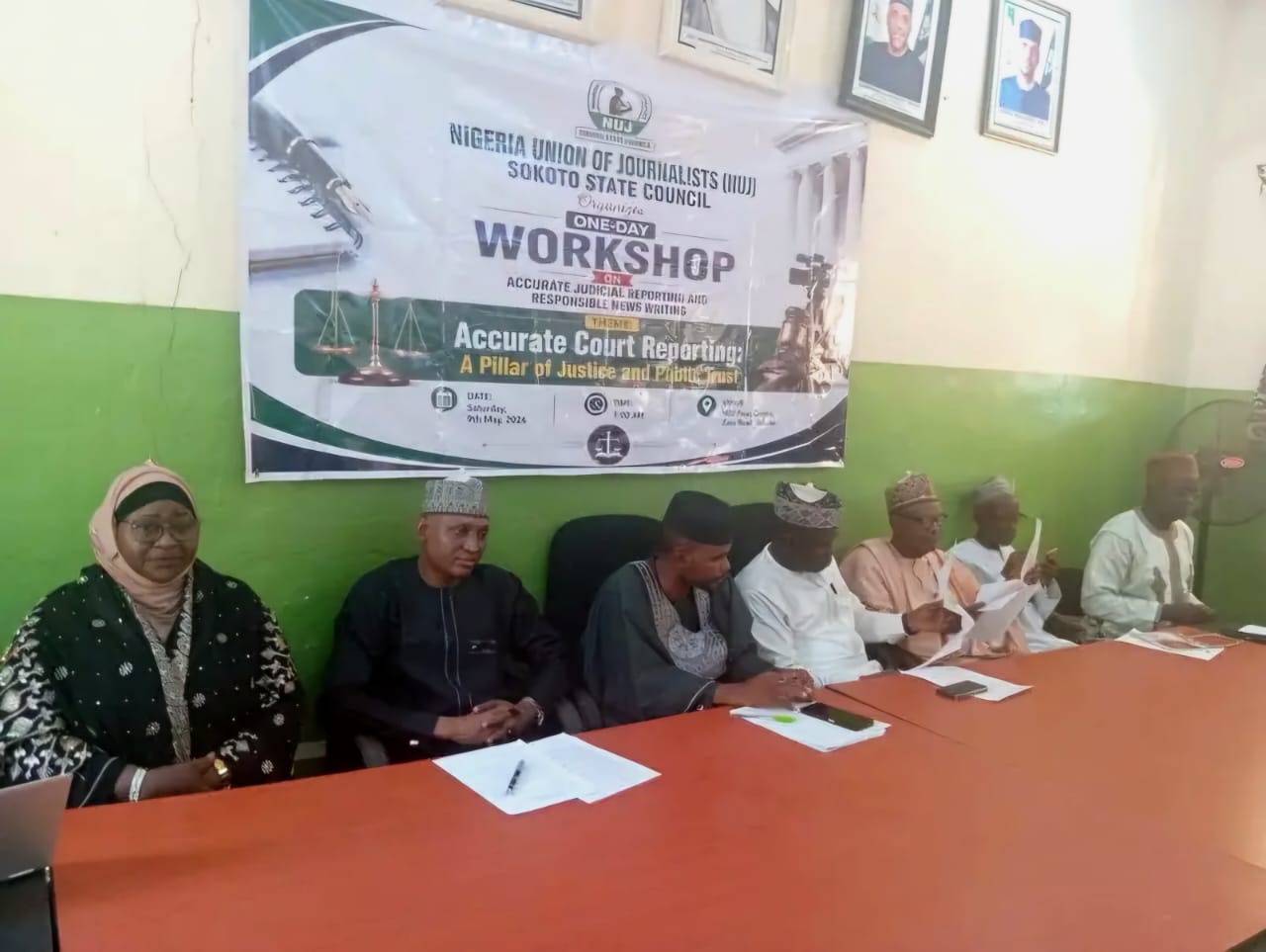
The Nigeria Union of Journalists, Sokoto State Council, has organised a capacity-building initiative to help members excel in judicial reporting and promote justice, fairness, and accountability while maintaining high ethical standards.
At the workshop’s opening, NUJ Chairman Usman Binji said the event was designed to provide participants with practical knowledge and a deeper understanding of judicial processes, legal boundaries, ethical challenges, and responsible news writing.
“Judicial reporting is one of the most sensitive areas of journalism. It requires accuracy, fairness, balance, patience, and a high level of ethical responsibility,” he highlighted.
“The way journalists report court proceedings directly influences public understanding of the justice system and shapes public trust in both the judiciary and the media.”
The NUJ chairman described the workshop theme, “Accurate Court Reporting: A Pillar of Justice and Public Trust,” as a reminder that democracy and justice thrive only when information reaching the public is factual, balanced, and professionally presented.
He emphasised that, as misinformation spreads and legal issues are often misunderstood, journalists should remain committed to truth, responsibility, and ethical standards.
Binji urged them to reflect on their vital role, emphasising that reports should educate and inform the public rather than create confusion.
He expressed appreciation to the Sokoto State government, led by Dr Ahmed Aliyu Sokoto, for its support of the NUJ Sokoto State Council and acknowledged the contributions of other stakeholders and partners.
The Chairman noted that the support demonstrates a shared commitment to advancing journalism and building public trust through accurate and responsible reporting.
Commissioner for Information Alhaji Bello Sambo Danchadi reaffirmed the state government’s commitment to supporting initiatives that promote professionalism, ethical journalism, and responsible information sharing.
“It is on record that the Ahmed Aliyu administration has undertaken several training programmes for working journalists and social media practitioners in the state, and more such trainings are in the pipeline,” he stated.
The Commissioner commended the NUJ Sokoto State Council for organising the timely workshop and highlighted the media’s crucial role in defending justice, advancing accountability, and supporting democracy.
“The judiciary remains one of the most sensitive and critical institutions in any democratic society. Court proceedings and judicial pronouncements influence governance and affect the lives of citizens,” he pointed out.
“Therefore, reporting judicial matters requires professionalism, accuracy, fairness, and a deep understanding of legal processes.”
The Commissioner described the workshop as a valuable opportunity for media professionals to strengthen their expertise in judicial reporting. “I strongly believe the knowledge gained here will contribute immensely to improving the quality of reportage in our state and beyond.”
He encouraged the NUJ to continue offering impactful capacity-building programmes for journalists in diverse fields.
