

Rakiya A.Muhammad
Scientists have used mathematical models to identify key factors behind Zika transmission. Their findings reveal targeted strategies such as deploying Wolbachia-infected mosquitoes could prevent outbreaks.
According to the World Health Organisation, Zika, which spreads mainly through Aedes mosquitoes, is associated with Guillain-Barré syndrome, neuropathy and myelitis in adults and children. Zika virus infection during pregnancy can cause congenital malformations in infants, preterm birth and miscarriage.
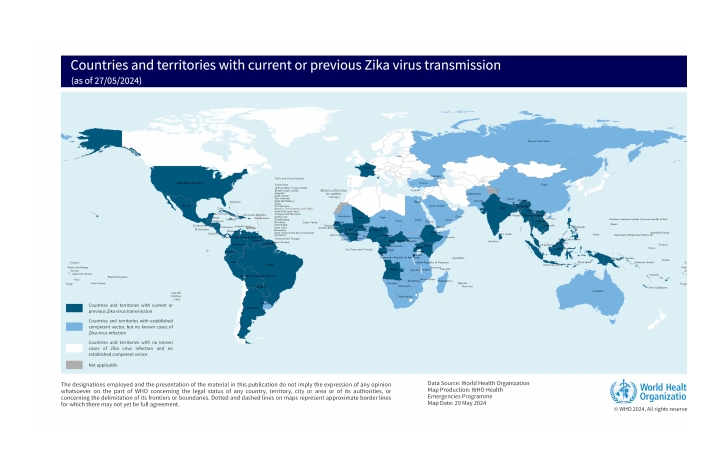
While Global cases have dropped since 2017, the virus still lingers in the Americas, Asia, and Africa. These regions also see sporadic outbreaks.
Understanding how diseases spread is essential in combating threats posed by organisms such as mosquitoes.
Armed with the analytical method known as Sensitivity Analysis, scientists are cracking the code of Zika. Sensitivity Analysis measures how changes in each variable affect the results of a mathematical model. With this, researchers are charting a course toward effective natural control.
“Sensitivity analysis of parameters contained in the reproduction number of an infectious disease helps to reveal how the parameters of the disease dynamics impact the spread of the disease, and in that case, suggest an appropriate method of control for the disease,” the scientists note.
The researchers include Michael Anyanwu, Emmanuel Duru of the Department of Mathematics, Michael Okpara University of Agriculture, Umudike, and Godwin Christopher Mbah of the Department of Mathematics at the University of Nigeria, Nsukka.
“The dynamics of the disease is modelled through a system of nonlinear ordinary differential equations, and the expression for the basic reproduction number of the disease is obtained, “the scientists explain further.
“Sensitivity analysis is conducted on the basic reproduction number, which reveals that the biting rate of the mosquito, the extrinsic incubation rate of the Zika virus and the probability of transmission of the Zika virus from mosquito to human are the major parameters that increase the spread of the disease.”
The researchers report that reducing the mosquito’s biting rate, shortening the virus’s incubation period, and lowering the probability of mosquito-to-human transmission can decrease Zika’s spread.
The analysis indicates that deploying Wolbachia-infected Aedes aegypti mosquitoes—mosquitoes with the relevant altered characteristics—may help control the disease.
“Stability analysis and numerical plots confirm that Zika virus disease can be controlled if the natural Aedes aegypti mosquitoes are replaced by the Wolbachia-infected ones,” they concluded.
